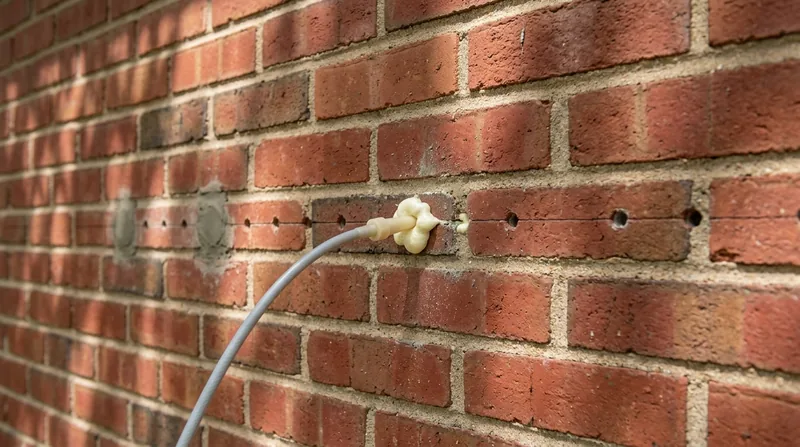




Wall and injection foam insulation in St. Louis fills empty cavities in frame and brick-veneer walls without tearing down drywall or siding. This retrofit works best on the 1940s-60s ranches that dominate the inner-ring suburbs from Kirkwood to Florissant, where original fiberglass has settled and left cavities exposed to outdoor air. St. Louis winters drop into the teens, and humid summers push moisture inward through walls that have no thermal break. Injection foam seals those cavities from inside, restores R-value, and stops air leakage at the source. It is not a solution for solid double-brick city homes like those in Soulard or Lafayette Square, where there is no cavity to fill. We tell you that upfront before anyone drills a hole.
Why Wall and Injection Foam Insulation Matters in St. Louis's Aging Housing Stock
The St. Louis metro is built on two distinct wall types. Older brick homes have solid masonry; newer ranches and split-levels have frame walls with cavities. When those cavities sit empty or when original fiberglass has compressed over fifty years, the wall becomes a conduit for cold and heat loss. Winter cold penetrates straight through, and summer humidity drives inward, causing condensation and mold risk on the rim joist and band board. Injection foam fills those voids without demolition, restores the thermal envelope, and stops the air leakage that makes heating and cooling work harder than it should.
- We drill small access ports through the rim or exterior wall, spaced every 16 to 24 inches along the cavity.
- We pump closed cell or open cell foam into the cavity until it is completely filled and the foam expands slightly to seal the edges.
- We patch the small holes with foam plugs and caulk, leaving almost no visible mark.
- The foam hardens in place and becomes part of the wall structure, adding strength and rigidity.
- No drywall removal, no siding removal, no weeks of mess or re-finishing.
This method is fast, clean, and effective for the brick-veneer ranches and frame cottages that line the neighborhoods of Affton, Bevo Mill, and Lindenwood Park.
Local example: A 1950s brick-veneer ranch in Webster Groves with empty wall cavities and no insulation in the rim joist loses heat continuously through the rim band and the exterior walls. Injection foam fills both the rim cavity and the wall cavities in a single day, restoring R-value and stopping the cold draft that pulls conditioned air out of the basement.
For more on how we approach the rim joist and band board in particular, see our Rim Joist and Band Joist Spray Foam service page.
According to the Missouri Department of Energy, improving wall insulation is one of the highest-impact retrofits for homes in the mixed-humid climate of Missouri.
How Injection Foam Insulation Works: The St. Louis Process
Injection foam is a retrofit-first method because it requires no demolition. We identify the wall cavities, locate the rim band and band joist, and then drill small 1.5-inch access holes at regular intervals. The foam is mixed on site to the exact ratio and temperature specified by the manufacturer, and we pump it into the cavity under controlled pressure. The foam expands, fills every void, and hardens to a solid state that resists settling, moisture, and air leakage. The entire process takes hours, not days, and your home stays dry and weathertight throughout.
- We perform a blower door test or visual inspection to locate air leakage paths and identify which cavities are empty.
- We drill access ports through the rim board or exterior wall at strategic locations along the cavity run.
- We set up mechanical ventilation during foam cure to manage any off-gassing and ensure safe air quality inside your home.
- We pump foam into the cavity until it reaches the back of the cavity and slightly overflows, confirming complete fill.
- We allow 24 to 48 hours for full cure before we patch the holes and seal the rim with caulk or sealant.
- We document the R-value, foam thickness, and coverage in a written estimate and completion report.
This controlled, measured approach is what separates professional insulation work from quick-flip crews that spray and leave before the smell settles.
St. Peters example: A 1960s split-level with an exposed rim joist and empty wall cavities in the bonus room above the garage. We drill access ports from inside the basement, pump closed cell foam into the rim cavities, and inject open cell foam into the bonus room walls. The rim is sealed, the bonus room stops sweating in summer, and the basement no longer smells like the outdoors. Total time on site: one day.
For a full breakdown of the difference between closed cell and open cell foam, see Closed Cell Spray Foam Insulation in St. Louis.
| Approach | Description | Best for |
|---|---|---|
| Closed cell injection | High-density foam, 3.5 to 3.8 R-value per inch, vapor barrier, fills small voids completely. | Rim joists, band boards, and rim cavities where moisture and air leakage are the primary concern. |
| Open cell injection | Lower-density foam, 3.5 to 3.6 R-value per inch, vapor-permeable, softer feel, lower cost. | Interior wall cavities in frame houses where vapor drive is managed by interior air barriers. |
| Combination (rim plus walls) | Closed cell in the rim band, open cell in the wall cavities above, one drilling session. | Retrofit ranches and split-levels where both rim and wall cavities need insulation and air sealing. |
| Solid brick assessment | Visual inspection confirms no cavity exists; no drilling, no foam, no cost. | Double-wythe brick homes in Soulard, Tower Grove, and Shaw where injection foam cannot be applied. |
Wall and Injection Foam Insulation Cost in St. Louis: What to Expect
Injection foam pricing in St. Louis runs from $2 to $4 per square foot of wall cavity, depending on the foam type, cavity depth, and accessibility. A typical rim joist and wall cavity retrofit on a 1,500-square-foot ranch costs between $3,500 and $7,000. Closed cell foam costs more than open cell but provides a vapor barrier and higher R-value per inch, which justifies the premium for rim joists and areas prone to moisture. Open cell is less expensive and performs well in interior wall cavities where vapor management is not the limiting factor.
Factors that affect the final price include the linear feet of rim board to be sealed, the number of wall cavities, the depth of the cavity, and whether you need insulation removal first to clear out old fiberglass or debris. A cavity that is accessible and clear takes less time and costs less than one that requires partial demolition or careful navigation around plumbing and electrical work. Getting 2 to 3 estimates from local contractors is the smart move, because each estimate should show the R-value, the thickness of foam, the linear feet of coverage, and the foam type specified. A price with no details is a red flag.
For detailed pricing on all our services, visit our pricing page.
Wall and Injection Foam Insulation Near Me: What St. Louis Homeowners Should Know When Hiring
When you are looking for a spray foam contractor near St. Louis, ask for proof of current insurance coverage, a written estimate with R-value and foam thickness specified, and at least two references from jobs completed in the past 12 months. Verify that the contractor has experience with the specific wall type in your home (frame versus brick-veneer) and understands the local building code that applies at your address. Ask whether the contractor will set up mechanical ventilation during the cure period and what the re-entry window is, because a responsible installer will require 24 to 48 hours before occupancy.
- Request a written estimate that specifies the foam type, the R-value per inch, the thickness, and the linear feet of cavity to be filled.
- Ask whether the contractor is fully insured and ask to see a certificate of insurance naming you as an additional insured for the duration of the work.
- Verify that the contractor understands local permit requirements, because some cities require notification or inspection of foam work in occupied homes.
- Check references and ask about the contractor's experience with your specific wall type and the age of your home.
- Confirm that mechanical ventilation will be used during cure and that the contractor will provide a re-entry window in writing.
- Ask for a workmanship warranty in writing, typically 1 to 3 years, covering the integrity of the foam and the seal.
The best contractor is the one who takes time to understand your home, gives you a detailed estimate, and is reachable after the job is done. Call us at (314) 912-1801 for a free estimate and to discuss your specific situation.
For more on how to find and vet a contractor, visit our contact page to schedule your free consultation.
Wall & Injection Foam Insulation in St. Louis: Pricing Guide
| Service | Price | Details |
|---|---|---|
| Rim joist and band board injection (closed cell) | Starting at $2.50/sq ft | Closed cell foam, 1.5 to 2 inches thick, complete seal of rim cavity, includes access drilling and patching |
| Wall cavity injection (open cell) | Starting at $2/sq ft | Open cell foam fills frame wall cavities 3.5 to 5.5 inches deep, no vapor barrier needed, lower cost than closed cell |
| Combination retrofit (rim plus walls) | Starting at $3/sq ft | Closed cell in rim, open cell in walls, single drilling session, covers both air leakage points in one job |
| Insulation removal before injection | On estimate | If old fiberglass or debris must be cleared first, cost depends on volume and disposal requirements |
| Travel and site assessment | Included | No mileage fee or travel charge in St. Louis and surrounding suburbs, free initial inspection |
| Estimate | Free | Written estimate with R-value, thickness, and coverage details, response within 24 hours at (314) 912-1801 |
Indicative pricing, the exact cost depends on square footage, finish, and site access. Free personalized estimate within 24h at (314) 912-1801.


