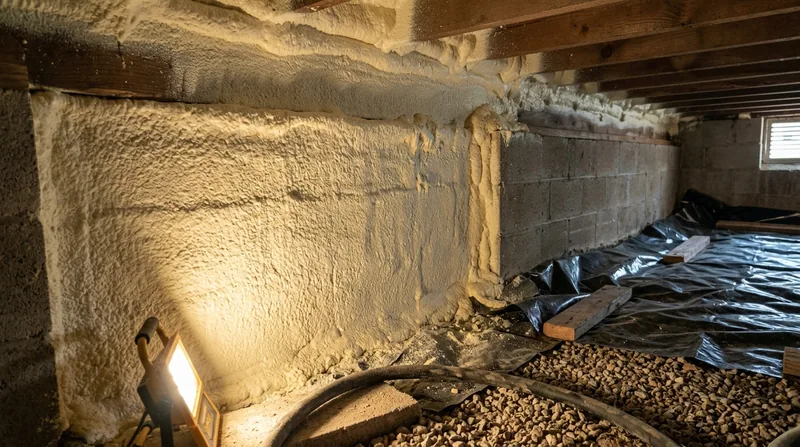




Crawl Space Spray Foam Insulation in St. Louis is the fastest way to stop cold floors in winter and damp air in summer. Almost every home in St. Louis sits on a basement or crawl space, and that exposed rim joist, band beam and subfloor are the leakiest, coldest part of the structure. Closed-cell foam seals those spaces tight, blocks moisture migration, and keeps the first floor warm year-round. St. Louis basements and crawl spaces face two distinct problems: January cold that radiates up through the rim joist into the kitchen and bedroom above, and August humidity that seeps through block walls and soil contact, making the whole first floor clammy. Spray foam fixes both at once. We spray the walls, band joist and subfloor deck with closed-cell foam, seal every gap and crack, and eliminate the air leakage that no fiberglass batts can match. The result is a conditioned crawl space that stops the cold drafts and the moisture cycle that ages joists and sills.
Why Crawl Space Insulation Matters in St. Louis's Mixed-Humid Climate
St. Louis sits in a mixed-humid climate where vapor drive flips with the seasons. In winter, cold crawl space air leaks up through gaps in the rim joist and subfloor, making the kitchen and first-floor bedrooms feel drafty and cold. In summer, humid outdoor air enters the crawl space through vents and rim joist gaps, and that moisture condenses on cool concrete and wood, promoting rot in rim joists and floor framing. Traditional fiberglass batts in rim joists don't stop air movement, and crawl space vents actually make the humidity problem worse in summer. Closed-cell spray foam seals the entire assembly, blocks air infiltration, and controls the moisture that damages wood over decades.
- Stops cold air leakage through rim joists and band beams that make first-floor rooms feel drafty in January.
- Prevents humid summer air from entering the crawl space and condensing on wood framing and concrete.
- Seals gaps around pipes, ducts and electrical penetrations that fiberglass cannot reach.
- Creates an air barrier that reduces the load on your HVAC system year-round.
- Protects wood rim joists and sills from moisture-driven decay that shortens their lifespan.
Crawl space insulation is the single most cost-effective upgrade for homes in St. Louis because the rim joist and subfloor are the leakiest part of the envelope and the easiest to seal.
Key info: St. Louis homes in Kirkwood, Webster Groves and Chesterfield built in the 1950s and 1960s often have no rim joist insulation at all. Brick-veneer ranches on block basements with poured rim beams are the most common target. A 1,500-square-foot ranch with an uninsulated crawl space loses heat through the rim joist and subfloor all winter, and gains moisture through the same path all summer.
For more context on how spray foam works in different parts of your home, see our guide to closed-cell spray foam insulation.
How We Insulate Crawl Spaces in St. Louis: The Process
Crawl space insulation starts with a moisture assessment. If the crawl space has standing water, active leaks, or wet soil, we fix the moisture source first or we walk away. Once the substrate is dry, we spray closed-cell foam on the rim joist, band beam and the first 2 to 3 feet of the foundation wall, and we extend the foam across the subfloor deck above. The foam cures to a rigid, waterproof barrier that blocks air and moisture. We use mechanical ventilation during spray and cure, and we observe a 24 to 48-hour re-entry window before the space is occupied.
- We inspect the crawl space and test for moisture, standing water or active leaks before any foam is applied.
- We address drainage or water intrusion issues first, because foam does not fix a wet space.
- We mask and protect ducts, electrical panels and any equipment in the space.
- We spray closed-cell foam on the rim joist, band beam, foundation walls and subfloor deck to R-19 or R-21 depending on your local code.
- We apply mechanical ventilation throughout the spray and cure process to manage VOC off-gassing.
- We provide a written estimate with R-value, thickness in inches, and the square footage of coverage.
The entire process for a typical 1,500-square-foot crawl space takes one to two days, including cure time.
Local example: A 1920s brick bungalow in Bevo Mill with a stone foundation and a damp crawl space smelling of mold. We sealed the rim joist and subfloor with 2 inches of closed-cell foam, which brought the R-value to about R-14 on the rim and R-12 on the subfloor deck. The first-floor bedroom above the crawl space went from 58 degrees in January to 66 degrees, and the musty smell disappeared because we eliminated the humid air pathway.
See how we handle rim joist and band joist insulation on its own, or as part of a whole-home air sealing strategy.
Crawl Space Insulation Methods: Closed-Cell Foam and Alternatives
Closed-cell spray foam is the standard for crawl spaces because it is rigid, waterproof and air-tight. It also has the highest R-value per inch (R-6 to R-7 per inch) of any insulation product, so you can achieve code-required R-values in 2 to 3 inches without taking up much space. Fiberglass batts and blown-in cellulose are cheaper but do not stop air leakage and absorb moisture, which makes them poor choices for crawl spaces where humidity and air movement are the problem.
| Approach | Description | Best for |
|---|---|---|
| Closed-Cell Spray Foam | Rigid, waterproof foam sprayed to 2 to 3 inches on rim joists, band beams and subfloor. R-value R-6 to R-7 per inch. Cures in 24 hours. | Crawl spaces with moisture or humidity concerns, rim joists and band beams, any space where air sealing matters. |
| Open-Cell Spray Foam | Softer, more permeable foam. R-value R-3.5 per inch. Cheaper than closed-cell but absorbs moisture. | Not recommended for crawl spaces or any space with moisture risk. Better for attics and interior walls in dry climates. |
| Fiberglass Batts | Loose rolls of fiberglass stapled to rim joists. R-value R-3.2 to R-3.8 per inch. Does not stop air leakage. | Not suitable for crawl spaces. Does not block air or moisture. Absorbs water and loses R-value when wet. |
| Blown-In Cellulose or Mineral Wool | Loose-fill material blown into cavities. R-value R-3.2 to R-3.6 per inch. Requires air barrier to work. | Not recommended for crawl spaces or rim joists. Settles over time and absorbs moisture in humid conditions. |
Closed-cell foam is the only choice that solves both the air leakage and moisture problems that dominate crawl spaces in St. Louis.
Crawl Space Spray Foam Insulation Cost in St. Louis: What to Expect
Crawl space insulation in St. Louis starts at $2,500 to $4,000 for a typical 1,500-square-foot ranch or bungalow with a standard rim joist and subfloor. The cost depends on the square footage of rim joist and subfloor to be covered, the thickness of foam required by your local code (usually 2 to 3 inches), the condition of the substrate, and access. A dry crawl space with easy access costs less than a damp space that needs drainage work first, or a space with low headroom or tight rim joists that slow the spray process. Most homes in St. Louis pay between $3,000 and $5,500 for a complete crawl space insulation job, including the rim joist, band beam and subfloor deck.
Several factors move the price up or down. A larger crawl space footprint (2,000 square feet or more) raises the material and labor cost. A crawl space with standing water or active leaks requires drainage or sump pump work before we spray, which adds cost and timeline. A space with low headroom, restricted access, or obstacles like HVAC ducts or plumbing runs takes longer to spray. A space that has been treated for mold or rodents may need cleanup before we start. Conversely, a dry, clean, accessible crawl space with good drainage and a simple rim joist geometry costs less per square foot than a complex or compromised space.
The best way to know what your crawl space will cost is to request a free estimate. We inspect the space, measure the square footage, assess the moisture condition, and give you a written quote with R-value, thickness and the square footage of coverage. No obligation, no pressure, and we respond within 24 hours at (314) 912-1801.
For a full breakdown of pricing across all our services, see our pricing guide.
Crawl Space Spray Foam Insulation Near Me: What St. Louis Homeowners Should Know Before Hiring
Hiring the right spray foam contractor matters because bad work shows up immediately and lasts forever. Before you call anyone, verify that they are fully insured with a current certificate of insurance. Ask for references from three recent crawl space jobs in your city or a nearby suburb. Get two or three written estimates that include the R-value, thickness in inches, and the square footage of coverage. Do not accept an estimate with a price per board foot and no detail. Make sure the contractor explains whether permits are required at your address, and whether your crawl space needs moisture or drainage work before foam is applied. Some contractors will spray over a wet crawl space and promise the foam will fix it; that is a red flag. We fix the moisture first or we walk away.
- Ask for proof of insurance and request a copy of the certificate for your records.
- Get at least two written estimates that specify R-value, thickness and square footage covered.
- Ask whether the contractor will inspect the crawl space for moisture or water before spraying.
- Confirm that the contractor uses mechanical ventilation during spray and cure, and will observe a 24 to 48-hour re-entry window.
- Check whether your city or county requires a permit for spray foam insulation, and who pulls it.
- Ask about the warranty on the foam and the workmanship, and get it in writing.
The best contractors in the St. Louis area are local, responsive, and willing to answer questions. If a contractor is evasive about insurance, moisture assessment, or re-entry timing, find someone else. Contact us for a free estimate and a straightforward conversation about what your crawl space needs.
Crawl Space Spray Foam Insulation in St. Louis: Pricing Guide
| Service | Price | Details |
|---|---|---|
| Standard crawl space insulation | Starting at $2,500 | Rim joist, band beam and subfloor deck on a 1,200 to 1,500 sq ft home with dry crawl space and good access |
| Larger or complex crawl space | Starting at $4,000 | 2,000+ sq ft footprint, low headroom, obstacles like ducts or plumbing, or moderate moisture that requires drainage prep |
| Moisture assessment and remediation | On estimate | Standing water, active leaks or damp soil require drainage or sump work before foam can be applied safely |
| Travel and site visit | Included | No separate charge for travel within St. Louis and surrounding counties; free written estimate with R-value and thickness specs |
| Free estimate | No charge | Response within 24 hours at (314) 912-1801; we inspect the crawl space and provide a written quote with no obligation |
Indicative pricing, the exact cost depends on square footage, finish, and site access. Free personalized estimate within 24h at (314) 912-1801.


