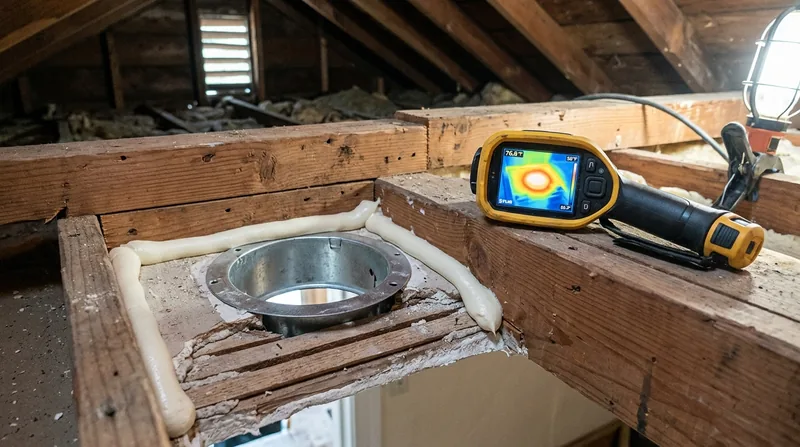




Air sealing in St. Louis stops the leak before you insulate. Top plates, can lights, chimney chases, and attic hatches in St. Louis homes leak more heated and cooled air than most walls. The rolling hills and basement stock that define the region mean every house sits on a foundation where warm air rises through the attic, and every degree matters in a climate that swings from 130-150°F in July to the teens in January. Sealing those leaks first is the step that makes every R-value actually perform. It is also the cheapest comfort fix in a St. Louis house, and the single biggest credibility differentiator between a spray foam shop that knows the trade and one that does not.
Why Air Sealing Matters More in St. Louis Than Most Places
St. Louis sits at the hinge between continental and humid subtropical climate zones. Winter air wants to escape upward through the attic; summer humidity wants to drive inward through walls and attics. The local building stock makes this worse. Balloon-framed Victorian frame houses in Kirkwood and Webster Groves, 1920s brick bungalows in St. Louis Hills, and the countless brick-veneer ranches built in the 1940s through 1960s in Florissant and Ferguson all have attics with no air barrier. Top plates, rim joists, and band joists sit open to the unconditioned space. Can lights punch holes in the ceiling. Chimney chases leak. Attic hatches fit loosely. The result is that a St. Louis attic is not just hot or cold, it is a conduit.
- Leaks at the top plate and rim joist account for 25 to 40 percent of attic air loss in homes built before 1980.
- A single recessed can light without an air-tight trim ring can leak 100 cubic feet per minute of conditioned air.
- Chimney chases and attic hatches are rarely sealed and act as direct ducts to the outdoors.
- Sealing these points first ensures that new insulation R-value is not wasted on heating and cooling the outdoors.
Air sealing is the foundation of every retrofit. Without it, you are insulating a leaky bucket.
Key info: A St. Louis home with a finished attic or knee-wall space in Bevo Mill or Lindenwood Park often has multiple penetrations where the HVAC duct, electrical wiring, and plumbing stacks meet the rim joist. Each one leaks. Sealing them before insulation turns a 1970s attic into a 2010s attic in one job.
For more on how insulation works in concert with air sealing, see our attic spray foam insulation page.
How We Seal Air Leaks in St. Louis Attics and Walls
Air sealing is forensics. We walk the attic or wall cavity with a thermal camera and a blower door test to find where air is moving. St. Louis homes built on basements and stone foundations often have rim joists that are partially exposed or buried. Attics in the older brick neighborhoods have rafters set directly into brick pockets with no rim board at all. We seal what we find with spray foam, caulk, or foam board, depending on the gap size and the substrate. The goal is to create a continuous air barrier before insulation goes in.
- We inspect the attic, crawl space, or wall cavity and identify all air leaks using thermal imaging and visual inspection.
- We seal top plates, rim joists, band joists, and band board junctions with spray foam or caulk.
- We seal can lights, exhaust fan boots, and duct penetrations with spray foam trim rings or foam board collars.
- We seal chimney chases, attic hatches, and access doors with gaskets, caulk, or foam.
- We verify the seal with a blower door test or visual inspection before insulation is installed.
The result is a home that holds temperature, not one that leaks it away.
Local example: A 1950s brick ranch in O'Fallon with a poured basement and an open rim joist lost an estimated 30 percent of its heating and cooling to air leakage at the rim. After sealing the rim, the rim joist, the top plate, and three can lights with spray foam, the homeowner reported a 15 percent drop in heating bills and an end to cold spots in the bedrooms. The attic insulation was never replaced, only sealed.
Learn more about how rim joist and band joist spray foam fits into the bigger picture.
Air Sealing Methods and Approaches
| Approach | Description | Best For |
|---|---|---|
| Closed-cell spray foam | 1.5 to 2 pound density foam applied to rim joists, top plates, and band joists. High R-value per inch and acts as both air and moisture barrier. | Basement rim joists, crawl spaces, and attic rim boards where moisture control and air sealing must happen together. |
| Open-cell spray foam | 0.5 pound density foam applied to top plates and attic junctions. Lower cost than closed cell, air-seals effectively, but is vapor-permeable. | Attic top plates, attic hatches, and interior wall cavities where cost is a factor and moisture is not a concern. |
| Caulk and gaskets | Polyurethane or acrylic caulk applied to small gaps. Weatherstripping gaskets applied to attic hatches and access doors. | Can light trim rings, exhaust fan boots, small penetrations, and hatch seals where foam is overkill. |
| Foam board and mechanical fastening | Rigid foam board cut to fit and screwed or nailed to rim joists, band boards, or around ducts. Acts as air barrier and insulation. | Exposed rim joists, crawl space band boards, and areas where spray application is not practical. |
Air Sealing Cost in St. Louis: What to Expect
Air sealing jobs in St. Louis range from small (a single attic hatch and a few can lights) to large (an entire rim joist and top plate in a 2,000-square-foot attic). Cost depends on the scope of leaks, the square footage of rim and top plate, the number of penetrations, and access. A small attic hatch and three can lights might run $650 to $900. A full rim joist and top plate seal on a 1,500-square-foot basement might run $1,200 to $2,000. A complete air sealing retrofit of an older St. Louis home with multiple zones, crawl space, and attic can run $3,000 to $5,000 or more.
The best way to know what your home needs is a free estimate. We walk your attic and basement, identify the leaks, and give you a written scope with R-value and thickness specs. For more detailed pricing guidance, see our full pricing overview. We respond within 24 hours at (314) 912-1801.
Air Sealing Near Me: What St. Louis Homeowners Should Know Before Hiring
Air sealing is only as good as the installer. A poor air sealing job looks fine from below but does nothing to stop air movement. Before you hire any contractor for air sealing in St. Louis, check three things. First, ask for an estimate that names the specific areas being sealed, the materials being used, and the expected R-value or air-tightness improvement. Second, ask for proof of insurance and the ability to verify coverage. Third, ask for references from recent jobs in your neighborhood. St. Louis has work crews that spray foam in an afternoon and disappear when the smell does not go away or the seal fails. The local independent contractor who stays in town and stands behind the work is a different proposition.
- Get a written estimate that names every penetration, junction, and gap being sealed.
- Verify that your local building department does not require a permit for air sealing work at your address.
- Ask whether the contractor carries insurance and can provide a certificate of insurance before work begins.
- Request references from homes in your city or neighborhood, not from out-of-state jobs.
- Ask about the re-entry window and ventilation requirements during cure if spray foam is being used.
A good air sealing contractor will ask you about your comfort problems, check your attic and basement, and explain what they found before giving you a price. That is the conversation that leads to a good outcome.
Ready to get started? Contact us for a free estimate. We serve St. Louis, Chesterfield, St. Charles, O'Fallon, St. Peters, Wentzville, Florissant, and Kirkwood.
Air Sealing in St. Louis: Pricing Guide
| Service | Price | Details |
|---|---|---|
| Attic hatch and can light sealing | Starting at $650 | Sealing one attic hatch and up to three recessed lights with gaskets, caulk, and trim rings in St. Louis attic |
| Rim joist and top plate sealing | Starting at $1,200 | Full rim joist and top plate seal on basement perimeter up to 1,500 square feet with closed or open cell foam |
| Complete air sealing retrofit | Starting at $2,800 | Attic, rim joist, crawl space, and all penetrations sealed in one project across multiple zones and floors |
| Complex or large-scale job | On estimate | Multi-story homes, finished attics, or crawl spaces with structural complications require on-site inspection for accurate quote |
| Travel and estimate | Included | No mileage fee or travel charge in St. Louis and surrounding areas. Free written estimate within 24 hours. |
Indicative pricing, the exact cost depends on square footage, finish, and site access. Free personalized estimate within 24h at (314) 912-1801.


