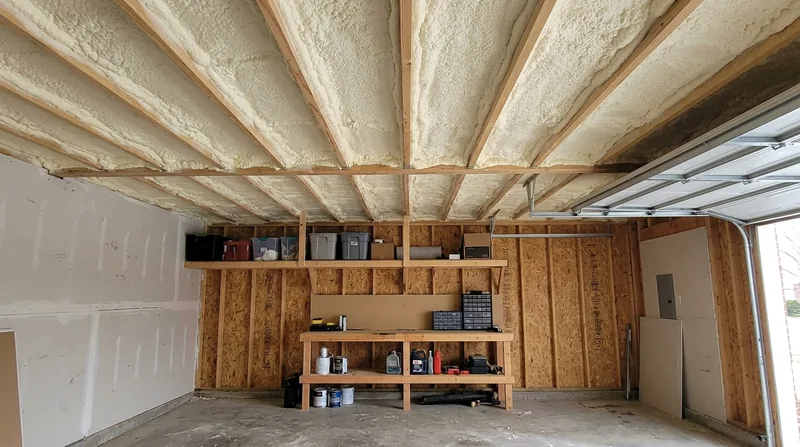




Garage spray foam insulation in St. Louis transforms a temperature-swinging box into usable space year-round. St. Louis summers push attic and garage ceilings past 140 degrees; winters drop them into the teens. Attached garages under bonus rooms or workshop conversions sit directly under the heat load and cold sink that makes them uncomfortable and expensive to condition. Spray foam seals the ceiling and shared walls against July heat bleeding into the second story and January cold radiating through into the house. The difference between a storage shed and a livable garage is controlled temperature, and that starts with the right insulation in the right place.
Why Garage Spray Foam Insulation Matters in St. Louis
St. Louis garages sit on poured or block basements, with ceilings that face either the attic above or a bonus room that needs isolation from the temperature swings outside. The mixed-humid climate means vapor drive flips with the seasons, outward in winter and inward during humid summers. A standard fiberglass or cellulose ceiling lets heat transfer straight through; a garage under a finished room becomes a thermal bridge that forces the HVAC system to work harder and still delivers uneven comfort. Spray foam solves both problems at once: it seals the air leaks that fiberglass misses, and it creates a thermal break that keeps conditioned air upstairs where it belongs.
- Stops heat gain in July that radiates into bonus rooms and second-story bedrooms overhead.
- Blocks cold transmission in January from an unheated garage into the living space above.
- Seals the rim joist and band joist where the garage wall meets the foundation.
- Handles moisture control without requiring a separate vapor barrier in most cases.
- Works on garage ceilings under finished rooms, workshop conversions, and storage spaces.
The result is a garage that stays closer to the house temperature, reduces the load on your HVAC system, and makes the space usable for hobbies, a workshop, or storage without the extreme swings that make it unusable half the year.
Key info: A garage ceiling under a finished bonus room in Chesterfield or Ballwin faces the same 130-degree summer peak and January deep freeze as any attic. Spray foam rated to R-20 or R-24 on that ceiling is the single most effective upgrade to make the room upstairs comfortable and reduce the load on your central air.
How We Spray Foam a Garage Ceiling in St. Louis: The Process
Garage insulation starts with understanding what you are conditioning. If the garage ceiling opens to an attic, we seal the perimeter rim and band joist first, then spray the ceiling with open cell or closed cell foam to the thickness needed for your R-value target. If the garage sits under a finished bonus room, the foam goes on the underside of the roof deck or the ceiling framing, creating a thermal barrier between the garage and the conditioned space. If the garage is detached, we focus on the ceiling and the walls shared with the house. The work takes a day or two depending on square footage, and the space is ready to use within 24 to 48 hours after the foam cures.
- We inspect the ceiling framing and identify any leaks, damage, or moisture before we spray.
- We install mechanical ventilation to manage off-gassing during the cure period.
- We apply foam in controlled passes, maintaining the manufacturer's ratio and temperature specs.
- We trim and clean the cured foam to match the ceiling line and prepare for drywall or finish.
- We provide a written estimate with the R-value and thickness specified for your job.
This process keeps the foam quality consistent and gives you a documented record of what was installed and where. See our air sealing page for details on how we handle the rim and band joist as part of the same project.
Example: A Webster Groves home with a two-car garage under a finished bonus room had the original fiberglass insulation compressed to nearly zero R-value. We removed it, sealed the rim joist with closed cell foam, and sprayed the ceiling with 4 inches of closed cell (R-24). The bonus room stayed within 5 degrees of the main house in July and January, and the garage stayed 15-20 degrees cooler than outside in summer.
Garage Spray Foam Methods: Open Cell vs. Closed Cell
| Approach | Description | Best for |
|---|---|---|
| Open Cell Spray Foam | Softer, lower density foam that expands after spraying. Low-VOC once cured. Absorbs sound. R-value around 3.5 to 3.7 per inch. | Garage ceilings where cost is the priority and the space is not exposed to standing water or high humidity extremes. |
| Closed Cell Spray Foam | Denser, more rigid foam with better moisture resistance. R-value around 6 to 7 per inch. Adds structural strength and handles vapor drive in both directions. | Garage ceilings under bonus rooms, garages in humid areas, or where the rim joist needs moisture protection and high R-value per inch. |
| Closed Cell on Rim and Band Joist | Targeted foam application on the band joist where the house rim meets the foundation. Seals air leaks and provides moisture control at the thermal bridge. | Every garage insulation job in St. Louis, as the rim joist is the leak point that fiberglass and blown-in cannot reach. |
| Removal and Replacement | We remove failed or compressed fiberglass, cellulose, or old foam, dispose of it, and spray new foam. Includes air sealing of any gaps or holes left behind. | Older garages in St. Louis Hills, Kirkwood, or Florissant where the original insulation has settled or is wet. |
Open cell is the price-friendly choice for a basic garage ceiling; closed cell is the right call when the garage sits under a finished room or when the rim joist needs moisture protection. See our closed cell spray foam page for a deeper look at the moisture and thermal performance trade-offs.
Garage Spray Foam Insulation Cost in St. Louis: What to Expect
Garage ceiling spray foam in St. Louis typically starts at $1,200 for a single-car garage with a straightforward ceiling and no removal work. A two-car garage runs $1,800 to $2,500 depending on the foam type (open cell or closed cell), the target R-value, and whether the rim joist needs sealing. If we remove old insulation first, add $300 to $600. If the garage walls are shared with the house and need foam as well, the scope grows and the cost moves higher. A workshop conversion or a garage under a finished bonus room may run $2,500 to $4,000 because the area is larger and the thermal requirements are stricter.
The biggest variables are the square footage of the ceiling, the type of foam (open cell costs less, closed cell costs more but delivers higher R-value per inch), the thickness needed to hit your R-value target, and any existing insulation that needs removal and disposal. Travel is included in St. Louis and surrounding areas. We provide a free written estimate with the R-value and thickness specified for your job, so you know exactly what you are getting before work starts.
To get an accurate number, contact us for a free estimate at (314) 912-1801. We respond within 24 hours and can walk you through the cost trade-offs between open cell and closed cell based on your space and budget. See our full pricing overview for more detail on all service types and what moves the cost up or down.
Garage Spray Foam Insulation Near Me: What to Look for When Hiring a Contractor
Spray foam insulation is not a DIY project, and hiring the right contractor matters more than the product itself. A bad installation (wrong ratio, poor thickness control, immediate re-entry promised, no mechanical ventilation during cure) creates smell complaints, voided manufacturer warranties, and wasted money. A good installation (controlled passes, correct drum temperature, mechanical ventilation, a stated 24 to 48 hour re-entry window, and a written estimate with R-value and thickness) is quiet, performs as promised, and lasts. Here is what to verify when you call a spray foam contractor in St. Louis, Chesterfield, Kirkwood, or any of our service areas.
- Ask for a written estimate that specifies the R-value, the foam thickness in inches, and the square footage being covered.
- Verify the contractor is fully insured and ask to see proof of general liability coverage for the work area.
- Ask how the contractor handles mechanical ventilation during cure and what re-entry window is recommended.
- Get at least two estimates so you can compare method, material, and price side by side.
- Check references from recent garage or bonus room insulation projects in your neighborhood.
- Ask whether the contractor pulls permits if your city requires them, or helps you understand what applies at your address.
Red flags include an estimate with no R-value or thickness, a price far below market with no inspection, a contractor who promises immediate re-entry, or insurance that cannot be verified. The best signal is an estimate that walks you through the work step by step and explains why the method and material are right for your garage. Call us at (314) 912-1801 to talk through your garage insulation needs and get a free, no-obligation estimate with all the details spelled out.
Garage Spray Foam Insulation in St. Louis: Pricing Guide
| Service | Price | Details |
|---|---|---|
| Single-car garage ceiling | Starting at $1,200 | Open cell foam, R-13 to R-15, includes rim joist sealing and removal of failed insulation if present |
| Two-car garage ceiling | Starting at $1,800 | Open cell or closed cell, R-15 to R-24, depends on foam type selected and whether walls require foam |
| Garage under finished bonus room | Starting at $2,500 | Closed cell foam, R-24 minimum, includes ceiling and wall sealing for thermal isolation and moisture control |
| Insulation removal and replacement | Add $300 to $600 | Removal of old fiberglass or cellulose, disposal, and replacement with new spray foam to code |
| Travel and estimate | Included | No separate mileage charge in St. Louis and surrounding areas; free written estimate within 24 hours |
Indicative pricing, the exact cost depends on square footage, finish, and site access. Free personalized estimate within 24h at (314) 912-1801.


