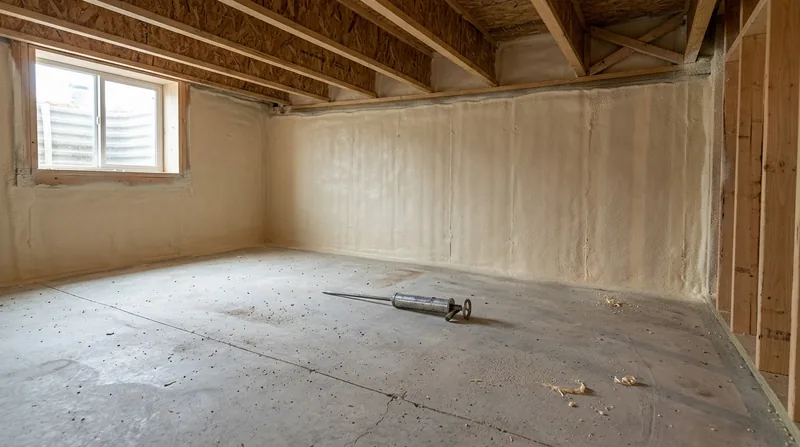




Closed cell spray foam insulation in St. Louis is the engineered answer to the vapor-drive problem that defines this climate. St. Louis sits on limestone karst with nearly universal basements, attics that swing from 150 degrees Fahrenheit in July to below freezing in January, and a mixed-humid climate where moisture pressure reverses between seasons. Closed-cell foam at two pounds per cubic foot delivers R-6.5 per inch with its own vapor retarder built in, meaning it handles both outward winter vapor drive and inward summer moisture without relying on a separate air barrier. That structural stiffening also matters on the rim joists and foundation walls where St. Louis basements meet the frame, and on metal buildings and barndominiums where condensation on steel has ruined insulation for decades. We spray closed-cell foam where the vapor problem is real and the R-value per inch matters most.
Why Closed Cell Spray Foam Matters in St. Louis Basements and Rim Joists
St. Louis basements are built on poured concrete and concrete block set into fieldstone or clay, and they sit in a water table that rises with spring snowmelt and heavy thunderstorms. The rim joist, where the floor frame meets the foundation top, is the single coldest point in the house in winter and the path where humid basement air finds its way into wall cavities and attics. Closed-cell foam seals that junction completely and resists moisture from both directions. On foundation walls themselves, closed-cell foam stops vapor from driving inward through the concrete during humid summers while keeping winter condensation off the interior surface.
- Closed-cell foam creates an air-tight seal that eliminates the thermal bypass at rim joists where fiberglass and open-cell foam leave gaps.
- The vapor retarder in the foam itself means no separate poly sheet is needed, simplifying installation and reducing the risk of vapor trapping.
- Structural stiffening from closed-cell foam reinforces rim joists and band joists that may flex or settle over time.
- Foundation walls insulated with closed-cell foam stay dry because the foam resists moisture penetration from both the exterior and interior.
These details separate a basement that stays stable and dry from one where condensation, mold risk, and energy loss compound year after year.
Local example: A 1950s brick ranch in Kirkwood with a poured concrete basement and a rim joist that pulls away from the band board in winter, letting cold air into the first-floor bedroom above. Closed-cell foam seals that gap, adds structural support, and blocks the vapor path that was feeding moisture into the wall cavity. The homeowner reports a 12-degree difference in that room within 48 hours of cure.
The St. Louis building code requires that any insulation applied to the interior of a basement wall meet fire code, and closed-cell foam systems in this area are installed with thermal barriers (typically drywall) that meet code. Always verify with your local building department what applies at your address, because code varies by city and by the year your house was built. You can find guidance on basement insulation and foundation work at the Missouri Secretary of State website, which maintains links to local building departments across the state.
How We Install Closed Cell Spray Foam in St. Louis Homes and Commercial Buildings
Closed-cell foam installation starts with a thorough site inspection to identify air leaks, moisture sources, and the substrate condition. We measure thickness and R-value to the specifications in your estimate, control the drum temperature and mix ratio per the manufacturer's system, and ventilate mechanically throughout the spray and cure process. The foam reaches its full R-value within 24 hours, but we recommend a re-entry window of 24 to 48 hours to allow odor to dissipate and the material to fully cure before the space is occupied or sealed.
- We inspect the substrate for moisture, active leaks, or contamination and address those before we spray, because foam applied over wet or damaged material will fail.
- We spray in controlled passes to achieve the thickness and density specified in your written estimate, never rushing to finish a job in a single afternoon.
- We provide mechanical ventilation during application and cure, and we post re-entry times at the work area so the homeowner knows when the space is safe to use.
- We seal all penetrations, rim joists, and rim board edges as part of the spray, creating a complete air barrier that stops thermal bypass.
- We remove old or failed insulation before we spray new foam, because layering foam over compressed fiberglass or wet cellulose traps moisture and causes problems downstream.
This process takes longer than a rig-and-run spray job, but it produces a durable, code-compliant result that stands up to St. Louis weather and seasonal vapor pressure.
Real scenario: A townhouse in Lafayette Square with a basement that floods during heavy rains and a first-floor wall that stays cold and damp. We remove the old fiberglass, dry the basement to a stable moisture level, spray closed-cell foam on the foundation wall and rim joist, and install mechanical ventilation during cure. The homeowner seals the sump pump and addresses the exterior drainage separately. The basement stays dry, the first floor warms up, and the vapor problem is solved at the source.
For more detail on how we handle insulation removal and preparation, see our insulation removal service page.
Closed Cell Spray Foam Applications: Methods and Best Uses
| Application | Description | Why Closed Cell |
|---|---|---|
| Rim and Band Joists | Sealing the junction where the floor frame meets the foundation top, typically 1 to 2 inches of closed-cell foam applied to both sides of the rim board. | Stops thermal bypass and vapor drive at the coldest point in the house; structural stiffening reinforces the rim. |
| Foundation Walls | Interior application of 2 to 4 inches of closed-cell foam on poured concrete or concrete block basement walls, typically with a thermal barrier (drywall) on top. | Vapor retarder is built in; resists moisture from both directions; meets code with thermal barrier; stops condensation. |
| Metal Buildings and Barndominiums | Spraying the underside of metal roof decks and interior walls to control condensation and thermal loss in pole barns, metal shops, and converted spaces. | Condensation on uninsulated steel is the defining problem; closed-cell foam's vapor retarder stops moisture before it condenses on the steel. |
| Sealed or Unvented Attics | Spraying the underside of the roof deck to create a conditioned attic that eliminates ice dams and improves comfort in finished bonus rooms and half-story spaces. | Closed-cell foam is rigid enough to support roof loads and provides R-6.5 per inch, reaching code R-value in 5 to 6 inches versus 10-plus inches of open cell. |
| Wall Cavities (Injection Foam) | Injecting closed-cell foam into hollow wall cavities of pre-1980 brick and frame houses without removing exterior brick or interior drywall. | Closed-cell foam's vapor retarder protects the brick and the frame from moisture; dense enough to fill cavities completely without settling. |
Each application leverages the same core properties of closed-cell foam: high R-value per inch, built-in vapor retarder, structural stiffening, and resistance to moisture from both directions. The choice of thickness and coverage is determined by your climate zone, the building code at your address, and the specific failure mode you are trying to prevent.
Closed Cell Spray Foam Insulation Cost in St. Louis: What to Expect
Closed-cell spray foam typically starts at $1.20 per board foot for straightforward applications like rim joists and foundation walls in the St. Louis area. The final price depends on several factors specific to your job: the total square footage and depth of the application, the condition of the substrate and whether old insulation must be removed first, the complexity of access (tight basement spaces cost more than open rim joists), and whether the job requires thermal barriers or other code-specific details.
A typical rim joist project in a St. Louis home (500 to 800 linear feet of rim board, 1.5 to 2 inches of closed-cell foam) runs between $1,800 and $3,500 depending on the foundation layout and access. A foundation wall in a basement (500 to 1,000 square feet, 2 to 3 inches of foam) typically ranges from $2,500 to $6,000. Metal building insulation and sealed attic projects are priced per board foot and quoted after an on-site inspection, because the roof area, deck condition, and ventilation requirements vary widely.
The best way to understand the cost for your specific project is to get a written estimate that includes the R-value, thickness in inches, total board feet, and the breakdown of labor and material. We recommend getting two to three estimates from local contractors so you can compare not just price but also the scope of work, the warranty, and the contractor's approach to ventilation and cure time. A price significantly below market often means shortcuts on thickness, ventilation, or cure time, and those shortcuts cost you money later.
See our full pricing page for ranges on other closed-cell applications and factors that affect cost.
What to Look for When Hiring a Spray Foam Contractor Near Me in St. Louis
Choosing a spray foam contractor is not a commodity decision. The difference between a contractor who follows the manufacturer's system and one who cuts corners shows up six months later as odor, settling, or moisture problems that cost thousands to fix. Start by asking any contractor for a written estimate that includes R-value per inch, thickness in inches, total board feet, and the re-entry window. If the estimate has no R-value and no thickness, walk away. Ask whether the contractor will provide mechanical ventilation during spray and cure, and what re-entry time they recommend. If they promise immediate re-entry or same-day occupancy, that is a red flag.
- Verify that the contractor carries full insurance and ask for a certificate of insurance naming your address as the project location.
- Ask for references from recent jobs in your neighborhood and call at least two homeowners to ask about odor, cure time, and how the foam has held up.
- Confirm that the contractor will remove old or failed insulation before spraying new foam, because layering foam over compromised material is a setup for failure.
- Check whether the job requires permits at your local building department and whether the contractor will help you navigate what applies at your address.
- Get a clear answer on the warranty: one to three years on workmanship is standard, and any promise of a lifetime warranty should be backed by a written document from the foam manufacturer.
The St. Louis area includes dozens of spray foam contractors, from national franchises to local one-truck operations. The local independent contractor with a local address and local phone number is positioned to stand behind the work because they live in this community and their reputation depends on it. Always verify any contractor's insurance status and approach before you sign a contract.
Ready to get a free, no-obligation estimate? Call us at (314) 912-1801 or visit our contact page to schedule an inspection. We respond within 24 hours and provide a written estimate with R-value, thickness, and board feet before any work begins.
Closed Cell Spray Foam Insulation in St. Louis: Pricing Guide
| Service | Price | Details |
|---|---|---|
| Rim Joist and Band Joist Sealing | Starting at $1.20/board ft | Sealing the rim board and band joist with 1.5 to 2 inches of closed-cell foam; linear footage and foundation type determine final cost |
| Foundation Wall Insulation | Starting at $1.20/board ft | Interior foundation wall coverage with 2 to 3 inches of closed-cell foam, typically 500 to 1,000 square feet per basement; substrate condition affects price |
| Metal Building and Roof Deck Insulation | On estimate | Sealed roof deck and interior wall spray for barndominiums and metal buildings; size, deck condition, and ventilation requirements require site inspection |
| Sealed Attic and Roof Deck Spray | On estimate | Spray-applied closed-cell foam to underside of roof deck for unvented attics and bonus rooms; square footage and existing insulation removal determine final cost |
| Travel and Site Inspection | Included | No separate mileage fee or travel charge within St. Louis and surrounding service areas; free written estimate within 24 hours of inspection |
Indicative pricing, the exact cost depends on square footage, finish, and site access. Free personalized estimate within 24h at (314) 912-1801.


