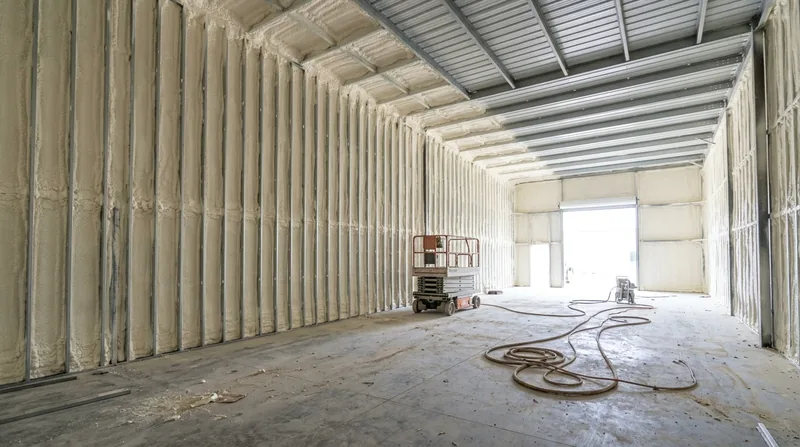




Commercial and new construction spray foam insulation in St. Louis demands more than a one-day rig and a trailer. Warehouses across Earth City and the Wentzville corridor, office shells along Interstate 70, churches and production builder homes throughout Chesterfield, Ballwin, and the inner-ring suburbs all require code-compliant assemblies that your county or city inspector will accept without pushback. St. Louis sits on basement foundations with seasonal vapor drive that flips from outward in January to inward in July, and new construction roofs over vaulted great rooms and bonus spaces need insulation that handles both directions without fail. Whether you are framing a new spec house in O'Fallon, insulating a metal warehouse in Fenton, or sealing a commercial shell in the Chesterfield Valley, the difference between a job that performs for twenty years and one that fails in three is specification, installation discipline, and local code navigation. We have served the St. Louis market since 2012 on schedule, with documentation your inspector will accept and phased work that keeps your operation running.
Why Commercial and New Construction Spray Foam Matters in St. Louis
The St. Louis climate and building stock create three non-negotiable pressures on commercial and new construction insulation. First, the mixed-humid climate means vapor can drive outward through cold winters and inward through humid summers, so every assembly must be vapor-safe in both directions. Second, the local building code requires specific thermal barrier and ignition barrier specifications that vary by city and by inspector, and getting this wrong means a failed inspection and a costly redo. Third, new construction in the I-70 corridor and the suburban growth rings moves on schedule, and a spray foam job that takes longer than promised or requires re-entry delays because of inadequate ventilation during cure can hold up framing, drywall, and the entire timeline.
- We specify closed cell or open cell foam based on use case, not on markup, and document R-value and thickness so your inspector has what he needs.
- We manage mechanical ventilation during cure so re-entry happens on schedule and your crew is not waiting in the parking lot.
- We pull permits where required and help you navigate what applies at your address, because permitting varies from city to city across Greater St. Louis.
- We work phased jobs on commercial shells so your tenants and operations are not disrupted by a single long spray day.
- We remove failed or contaminated insulation before we spray, because foam over a wet substrate or over old asbestos vermiculite is a liability we do not accept.
The result is a code-compliant, schedule-friendly insulation assembly that performs from day one and does not create callbacks or inspector disputes.
Key info: St. Louis requires thermal and ignition barriers in attics and sealed roof decks under the energy and building code in force at your address. The fifteen-minute thermal barrier distinction is the one most contractors misread. We specify it correctly and provide documentation your inspector will accept. Always defer to your local building department on what applies to your project.
For more on how we handle insulation in complex assemblies, see our closed cell spray foam page for technical depth on the product itself.
How We Execute Commercial and New Construction Spray Foam in St. Louis
Commercial and new construction work requires upfront specification, crew coordination, and documentation that residential work often skips. We start with a site visit to understand your building envelope, your code jurisdiction, and your schedule. We then specify the foam type, thickness, and barrier configuration in writing, and we provide that spec sheet to you and to your inspector before the first board foot is sprayed. During installation, we control spray temperature, drum ratio, and pass thickness to manufacturer standard, and we run mechanical ventilation during cure so your crew can re-enter on time. After cure, we document what was sprayed, where, and at what thickness, so you have proof of compliance.
- We conduct a pre-spray site visit and identify any moisture, contamination, or code issues that need resolution before we spray.
- We provide a written specification sheet naming the foam type, R-value, thickness, and thermal and ignition barrier configuration required by your local code.
- We spray in controlled passes using calibrated equipment and maintain mechanical ventilation during the entire cure window.
- We document the finished work with photos and a completion report that your inspector can reference.
- We schedule phased work on commercial shells so the rest of your trades are not held up by a single spray day.
This approach keeps your job on schedule and your inspector satisfied.
Example: A warehouse in Earth City required closed cell foam over a metal roof deck to control condensation during spring warm-up. We specified 2 inches of closed cell, provided the spec to the local building department, sprayed over two days with mechanical ventilation running continuously, and provided the completion report before the metal stud framing crew arrived. The job stayed on schedule and the inspector signed off without revision.
Learn more about our approach to metal building and barndominium insulation for similar commercial and industrial applications.
Commercial and New Construction Spray Foam Methods in St. Louis
| Approach | Description | Best for |
|---|---|---|
| Closed Cell Spray Foam | High-density foam (1.5 to 2.0 lbs per cubic foot) with an R-value of 6 to 7 per inch. Vapor-impermeable and provides air sealing in one pass. Requires mechanical ventilation during cure and a thermal barrier per code. | Metal roof decks, condensation-prone applications, sealed attics, and new construction where vapor control is critical. |
| Open Cell Spray Foam | Low-density foam (0.5 to 1.0 lbs per cubic foot) with an R-value of 3.5 to 4 per inch. Vapor-permeable, breathable, and lower cost. Requires mechanical ventilation during cure and a thermal barrier per code. | Interior wall cavities in new construction, sound dampening, and attics where vapor permeability is preferred. |
| Injection Foam Retrofit | Closed or open cell foam injected into existing wall cavities through small drilled holes. No demolition required. Adds R-value to pre-1980 masonry and frame walls without opening the wall. | Retrofitting brick and frame buildings in Lafayette Square, Soulard, and other historic districts where preserving the exterior is required. |
| Removal and Replacement | We remove failed, contaminated, or inadequate insulation (fiberglass, blown-in cellulose, old foam) before spraying new foam. Includes disposal and substrate preparation. | Commercial shells with existing insulation, warehouses with condensation damage, and any project where the old assembly must be cleared first. |
Commercial and New Construction Spray Foam Cost in St. Louis: What to Expect
The cost of commercial and new construction spray foam insulation in St. Louis depends on the foam type (closed cell or open cell), the square footage and thickness required, site access, the condition of the substrate, and whether existing insulation must be removed first. Closed cell foam, which is specified for metal roof decks and vapor-critical applications, runs higher per board foot than open cell foam, which is used in interior walls and attics where vapor permeability is acceptable. Large commercial shells and new construction projects benefit from economy of scale because the spray crew can work continuously without setup delays, while small or phased jobs carry higher per-board-foot costs because of mobilization and re-setup.
We provide a free commercial estimate after a site visit. The estimate includes the foam type, thickness, R-value, and total board feet required, plus the labor and material cost for the scope you outline. Factors that increase cost include removal of existing insulation, substrate repair (sealing cracks or patching damage), mechanical ventilation setup during cure, and code-required thermal or ignition barriers. The best way to understand your budget is to request a free estimate and ask for a line-item breakdown. We respond within 24 hours and will walk you through the spec and the cost so there are no surprises when the job starts.
For a detailed pricing overview that covers all our services, visit our pricing page.
What to Look for When Hiring a Commercial and New Construction Spray Foam Contractor Near St. Louis
Hiring the right spray foam contractor is the difference between a job that performs and one that creates callbacks and disputes. The St. Louis market includes both local shops and national franchises, and the best contractor for your project is the one that understands your local code, your schedule, and your performance requirements. When you call a contractor, ask for the following: a written estimate with R-value and thickness specifications, proof of insurance, references from commercial or new construction work in the past two years, and an explanation of how they manage ventilation during cure and how long re-entry takes after spray. Do not accept an estimate with no R-value and no thickness, or a promise that your crew can re-enter immediately after spray. Those are the hallmarks of work that will fail inspection or require a costly redo.
- Get a written estimate that names the foam type, R-value, thickness, and total board feet, plus labor and material costs and a timeline.
- Verify that the contractor is fully insured and ask for a certificate of insurance naming your project or your company as additional insured.
- Ask for references from commercial or new construction jobs completed in the past two years, and call at least two.
- Confirm that the contractor will manage mechanical ventilation during cure and provide a re-entry timeline before they start spraying.
- Understand who is responsible for permits and inspections, and whether the contractor will coordinate with your local building department.
- Ask what happens if the substrate is wet or contaminated, and whether the contractor will walk away rather than spray over a bad surface.
A contractor who answers these questions directly and provides documentation is the one you want on your project. Call us at (314) 912-1801 or request a free estimate online to see how we compare.
Commercial & New Construction Spray Foam in St. Louis: Pricing Guide
| Service | Price | Details |
|---|---|---|
| Free Commercial Estimate | Free | Site visit, written specification with R-value and thickness, and cost breakdown for your project scope |
| Closed Cell Spray Foam | Starting at $1.25 per board foot | Includes material, labor, mechanical ventilation during cure, and documentation for code compliance |
| Open Cell Spray Foam | Starting at $0.85 per board foot | Lower-cost option for interior walls and attics where vapor permeability is acceptable |
| Insulation Removal and Replacement | On estimate | Cost depends on existing material type, square footage, and disposal requirements; included in project estimate |
| Travel and Mobilization | Included | No separate charge for jobs in St. Louis and surrounding service areas; large commercial projects may have phased scheduling |
| Estimate Response Time | Within 24 hours | Call (314) 912-1801 or submit online; no obligation to book after estimate provided |
Indicative pricing, the exact cost depends on square footage, finish, and site access. Free personalized estimate within 24h at (314) 912-1801.


